
Baker's Percentage: The Only Math You Need for Bread
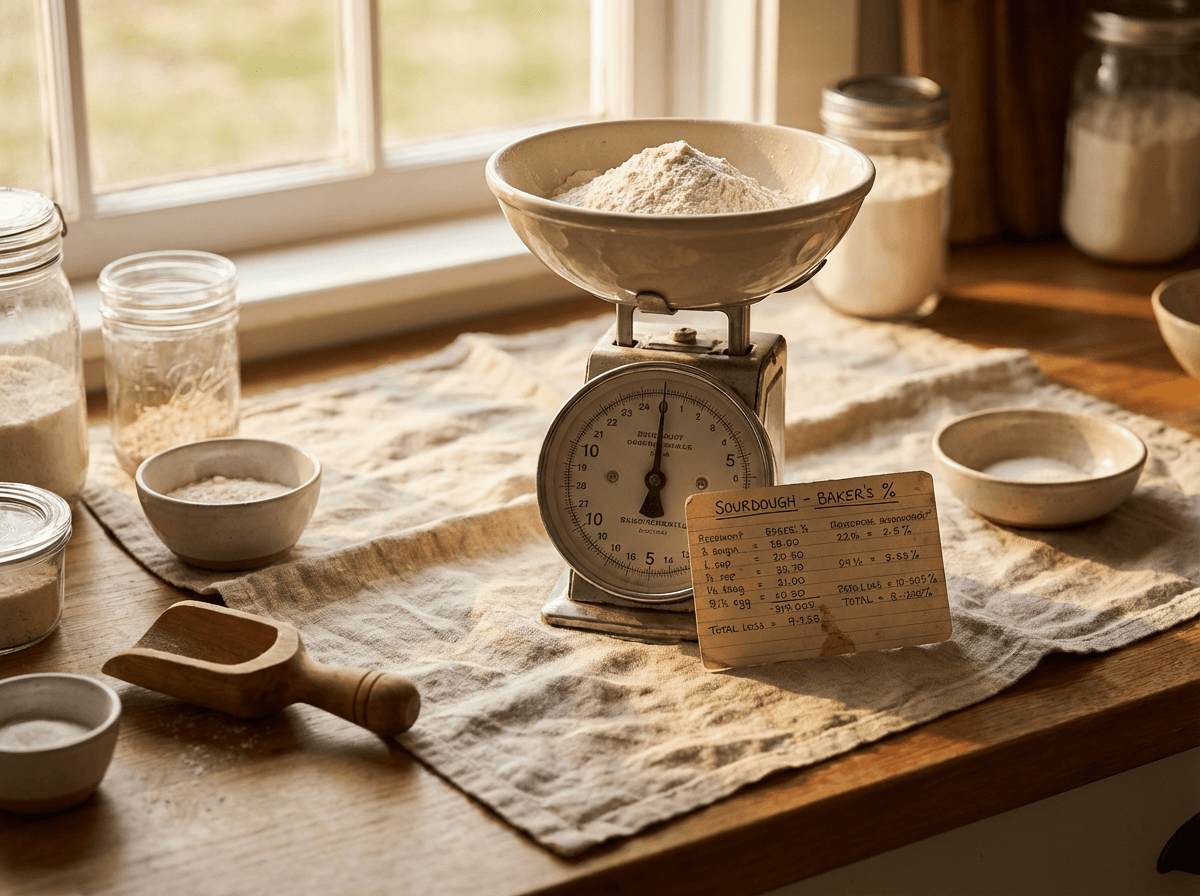
Baker's percentage is the simplest, most useful tool in bread baking. Once you get it, you'll never go back to volume measurements or fixed-quantity recipes. It makes every recipe instantly scalable and lets you compare any two bread formulas at a glance. You can learn the whole system in about two minutes.
The one rule: flour is always 100%
In baker's percentage, the total flour in your recipe is always 100%. Everything else is calculated as a percentage of that flour weight. That's the whole system.
Say you're using 1000g of flour. You want 65% hydration, 10% starter, and 2% salt. That means:
- Flour: 1000g (100%) - Water: 650g (65%) - Starter: 100g (10%) - Salt: 20g (2%)
Now say tomorrow you only have 500g of flour. Same percentages, half the amounts:
- Flour: 500g (100%) - Water: 325g (65%) - Starter: 50g (10%) - Salt: 10g (2%)
You didn't recalculate a thing. You just applied the same percentages to a different flour weight. That's the power of baker's math.
How to calculate baker's percentage
To convert any recipe to baker's percentage, divide each ingredient's weight by the total flour weight, then multiply by 100.
Example recipe: 400g bread flour, 100g whole wheat, 325g water, 50g starter, 10g salt.
Total flour = 400 + 100 = 500g. That's your 100%.
- Bread flour: 400 / 500 x 100 = 80% - Whole wheat: 100 / 500 x 100 = 20% - Water: 325 / 500 x 100 = 65% - Starter: 50 / 500 x 100 = 10% - Salt: 10 / 500 x 100 = 2%
To go the other direction -- converting percentages into grams for a specific amount of flour -- just multiply: flour weight x percentage (as a decimal) = ingredient weight. For 1400g of flour at 65% water: 1400 x 0.65 = 910g of water.
Why baker's percentage matters
Three reasons this system is worth learning.
First, scaling. You can take any recipe and make it for one loaf or fifty loaves. Change the flour weight, recalculate, done. No more guessing when you want to double a recipe or cut it in thirds.
Second, comparison. When someone says their recipe uses 75% hydration, you instantly know that's a wetter dough. When another recipe says 60%, you know it's drier. The percentages are a common language that works across any quantity.
Third, understanding. Once you think in percentages, you start to intuitively grasp how recipes work. You know that 2% salt is standard, that 5-20% starter is typical, that 60-75% water covers most bread styles. You can look at any new recipe and immediately tell if something seems off -- like 30% salt (that's a lot of salt) or 50% starter (that fermentation is going to be fast).
Converting a recipe you found online
Most online recipes give you fixed gram amounts or -- worse -- cups and tablespoons. Here's how to convert them to baker's percentage so you can actually scale them.
Step 1: Add up all the flour in the recipe. If it lists 3 cups bread flour, you'll need to convert to grams first (1 cup of bread flour is roughly 130g, but weighing is always better). Let's say the recipe has 500g total flour.
Step 2: Divide every other ingredient's weight by 500 and multiply by 100. Water 350g = 70%. Salt 9g = 1.8%. Starter 100g = 20%.
Step 3: Now you have the recipe in baker's percentage. You can scale it to any amount of flour you want.
One thing to watch: some recipes list "total dough weight" or include the weight of mix-ins like seeds or nuts. Seeds and inclusions are also expressed as a percentage of flour, but they don't count as part of the flour total. Only actual flour is 100%.
Common baker's percentages for sourdough
Here are typical ranges for sourdough bread. Use these as a starting point and adjust for your flour and preferences.
- Total flour: 100% (always) - Water: 60-75% for most loaves (beginners stay at 60%, experienced bakers push higher) - Sourdough starter: 5-20% (less in summer/warm kitchens, more in winter/cool kitchens) - Salt: 1.8-2.2% (2% is the standard default) - Whole wheat flour (if blending): 10-30% of the total flour is a nice range for flavor without making the dough too tricky
The starter percentage has a direct relationship with fermentation time. At 20% in a warm kitchen, bulk fermentation might finish in 5 hours. At 5%, it could take 12+ hours. Use less starter for slower fermentation -- slow fermentation makes better bread.
Once you internalize these ranges, you can create your own recipes from scratch. You don't need someone else's formula. You know the percentages, you know your flour, you know your kitchen temperature. That's everything.