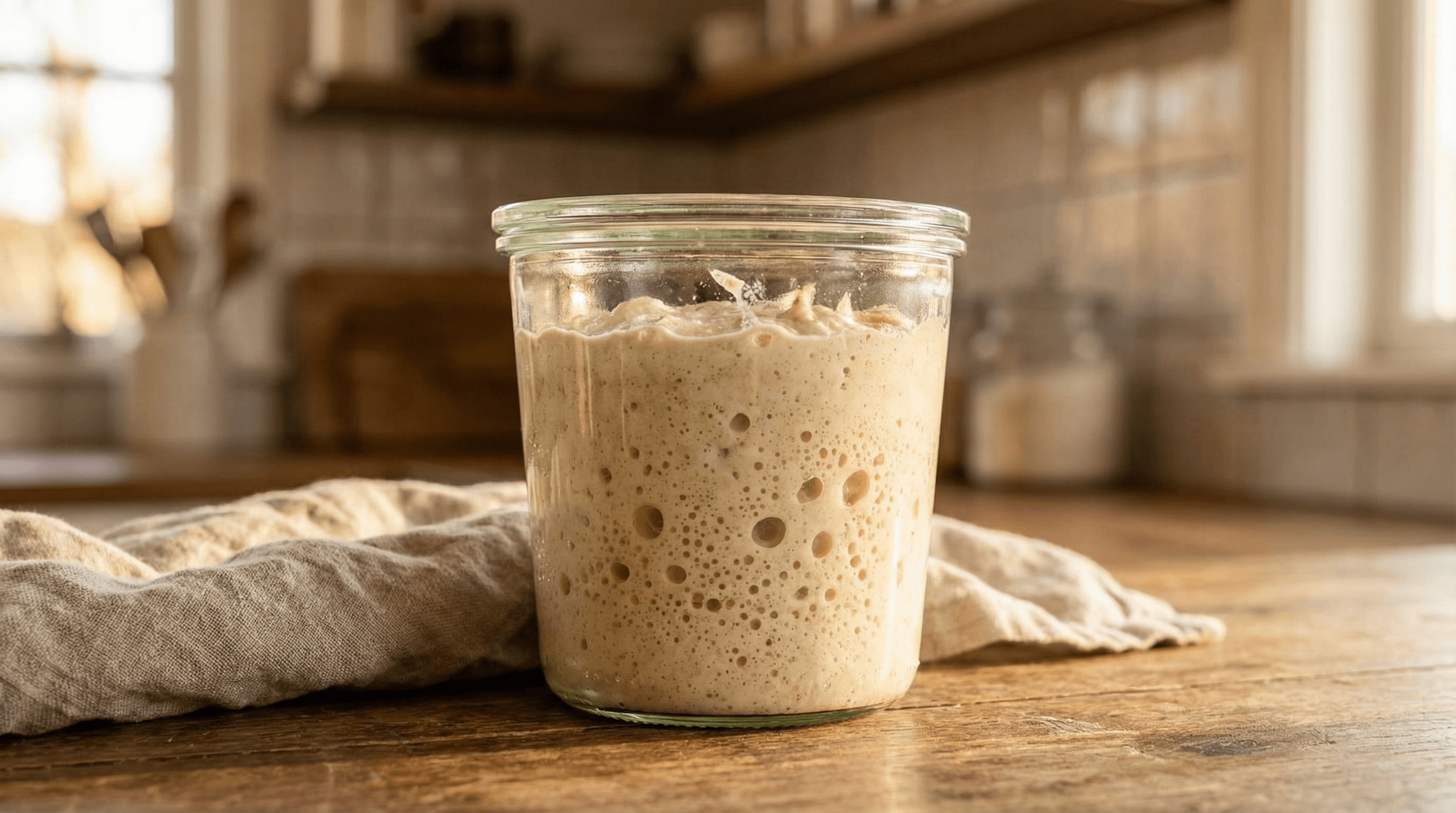
Making a sourdough starter is simpler than the internet makes it sound. You're mixing flour and water, then waiting for wild yeast and bacteria -- already present on the grain -- to move in and set up shop. Feed them daily, and within one to three weeks, you've got a living culture that'll leaven your bread for the rest of your life.
You don't need special equipment. You don't need a specific brand of flour. You definitely don't need to buy a dehydrated starter from someone on Etsy (though there's nothing wrong with it -- it's just unnecessary).
All you need is flour, water, a jar, and some patience.
A sourdough starter is a living ecosystem. Inside that jar of bubbly goop, millions of wild yeast cells and lactic acid bacteria are eating, reproducing, and producing the byproducts that make bread rise and taste good.
The yeast produce carbon dioxide (that's your leavening) and small amounts of ethanol. The bacteria produce organic acids -- lactic acid (mild, yogurty tang) and acetic acid (sharp, vinegary tang). Together, they create the distinctive sourdough flavor and the natural preservation that keeps sourdough bread fresh for a week without additives.
These microorganisms aren't coming from the air in your kitchen or from your hands (despite what some blogs claim). They're already on the grain. Wild yeast and bacteria live on the surface of wheat, rye, and other plants, existing in a symbiotic relationship where they protect the plant from pathogens in exchange for sugars. When you grind grain into flour, those microbes come along for the ride. Add water, and they wake up.
Flour, water, a container, and something to cover it. That's the whole list.
For flour, use whole-grain -- whole wheat, whole rye, whole spelt, whatever you have. Whole-grain flour has more microbial life on it because the outer bran layer (where most of the microbes live) is still intact. You can switch to white flour later once your starter is established. Organic flour is slightly better because it hasn't been treated with chemicals that might inhibit microbial growth, but conventional flour works fine for most people.
For water, avoid chlorinated tap water. Chlorine is added specifically to kill microorganisms -- exactly what you don't want here. Use filtered water, bottled water, or let tap water sit uncovered for 24 hours to let the chlorine evaporate. In many areas (like most of Germany), tap water is unchlorinated and works perfectly.
For the container, a glass jar works great. You want to see the sides so you can watch for bubbles and rising. Cover it loosely -- not airtight. You want some gas exchange. An inverted glass, a loose lid, or a kitchen towel secured with a rubber band all work.
A kitchen scale helps for consistency, but honestly, you can eyeball the proportions. This isn't chemistry lab.
Measure roughly 50g of whole-grain flour and 50g of water into your jar. Stir until all the flour is hydrated -- no dry clumps. That's it for day one.
What you've just done: activated millions of dormant microbial spores that were living on the grain. The enzymes in the flour (amylase and protease) have started breaking starches into sugars and proteins into amino acids. The stage is set for a microscopic battle royale.
Cover your jar and put it somewhere at room temperature. Not in direct sunlight, not next to a heat source. Just on your counter is fine.
An epic war is about to begin. Scientists have identified more than 150 different yeast species living on a single leaf of a plant. All of them -- plus bacteria, plus potential pathogens like mold -- are now waking up and competing for food. Only the microorganisms best adapted to fermenting flour will survive.
After about 24 hours, check your mixture. You might see some bubbles, a slight increase in volume, or a change in smell. Or you might see nothing obvious. Both are normal.
Take about 10g of your mixture and transfer it to a clean container. Add 50g of fresh flour and 50g of fresh water. Stir well, cover loosely, and set it aside. Discard the rest of the day-one mixture -- it may contain unwanted microorganisms that were active early on.
This 1:5:5 ratio (one part old culture, five parts flour, five parts water) is the one you'll use for every feeding going forward. It gives the microorganisms plenty of fresh food and dilutes the old, acidic culture enough that the yeast can rebalance.
Day 2 and 3 can feel discouraging. You might see a burst of activity on day 1 or 2 (lots of bubbles, rising) that then dies down to almost nothing. This is normal and expected. Those early signs were often from microbes that aren't great at fermenting flour. They burn bright and die off. The real sourdough microbes -- the ones that will take over permanently -- are still small in number, quietly multiplying with each feeding.
Keep feeding daily with the same 1:5:5 ratio. Take 10g from yesterday's mix, add 50g flour, 50g water. Discard the rest.
Somewhere around day 4-7, most starters begin showing consistent signs of activity. You're looking for three things:
1. Bubbles -- visible throughout the mixture, not just on the surface. This means yeast are producing CO2. 2. Rising -- any amount of size increase counts. Wheat starters tend to rise more than rye because wheat flour's gluten traps gas better. Don't stress about doubling. 3. Smell -- a pleasant tangy, slightly yeasty aroma. Not nail polish (acetone -- that's a sign of too much acetic acid, but it's not dangerous). Not vomit (that's butyric acid from early-stage bacteria that haven't been outcompeted yet). A good starter smells like sourdough.
If you're on day 7 and seeing nothing, don't give up. Some starters take two weeks or even longer, especially with certain flours. Try switching to a different flour. If your flour has been treated with chemicals, it might be inhibiting growth. Give it at least 10 days before trying a new flour.
Once your starter is showing all three signs of activity (bubbles, rising, tangy smell), it's alive. But "alive" and "ready to bake with" aren't the same thing.
A young starter can be weak. The balance of yeast to bacteria might not be optimal yet. The yeast might not be vigorous enough to leaven a full loaf. Keep feeding daily to let the culture strengthen and the microbial balance stabilize.
Each feeding is like a training session. The microorganisms that are best at fermenting flour get more food and reproduce faster. With each generation, your starter becomes more adapted to its environment -- your flour, your water, your kitchen temperature.
You'll know your starter is ready for its first bake when it consistently shows vigorous activity within 4-8 hours of feeding. At that point, give it one last feeding and make your dough the next day.
Your first loaf will probably be a flat, dense hockey puck. That's not a maybe -- that's a tradition. And honestly? It'll still taste better than anything from the store. Slice it, toast it, butter it. Then try again.
Feeding is simple: remove most of your starter, add fresh flour and water.
The standard ratio is 1:5:5 -- one part starter, five parts flour, five parts water by weight. So 10g starter + 50g flour + 50g water. This gives a 100% hydration starter (equal parts flour and water by weight).
Why 1:5:5 and not 1:1:1? Because a 1:1:1 ratio keeps too much old, acidic starter in the mix. The bacteria have already dominated that old culture, and they'll dominate the new one too, suppressing the yeast. A higher ratio of fresh flour gives the yeast room to rebalance. Your starter is essentially a miniature version of your bread dough -- you wouldn't make dough with 33% starter, so don't feed your starter that way.
When to feed depends on when you want to bake. If you're baking tomorrow, feed tonight. If you're baking in 8 hours, feed now. Adjust the ratio for timing: a 1:10:10 ratio takes longer to peak than 1:5:5, which is useful if you need your starter ready at a specific time.
Feed with whatever flour you plan to bake with, or use whole-grain flour for a more active culture. Room-temperature water, always.
Three things to check, every time:
1. Size increase -- has it risen since its last feeding? Any amount counts, but a rough doubling is a good benchmark for wheat starters. Rye starters may not double but will still be active.
2. Bubbles -- visible throughout the culture, especially on the sides of the jar. Bubbles on the surface alone aren't enough; you want to see them distributed through the mixture.
3. Smell -- a clean, pleasant tang. Lactic acid smells like yogurt. Acetic acid smells like vinegar. Both are fine. A sharp, pungent acetone smell means the starter is over-ripe and should be fed before using.
Combine all three indicators. One alone can be misleading. A starter can have bubbles but smell terrible (early days). It can smell good but not have risen (weak yeast). All three together give you confidence.
Forget the float test. A chunk of starter floats when it has enough trapped gas bubbles, but that doesn't reliably indicate peak activity. Rye starters almost never float. Dense, low-hydration starters often don't float. The three visual-and-smell checks above are far more dependable.
Your starter has mold: This is rare and usually happens when the surface dries out. If mold is only on the surface, scrape it off, take a small amount from the center, and start over in a clean jar. If mold has penetrated throughout, discard and start fresh. Prevent mold by keeping the surface moist -- some bakers add a thin layer of water on top.
Your starter smells like nail polish: That's acetone, a byproduct of certain bacteria. It means your starter is very hungry and has gone too long between feedings. Feed it with a 1:10:10 ratio to dilute the acids, and feed more frequently for a few days. It'll correct itself.
Your starter isn't rising at all after 10+ days: Try a different flour. Some commercially treated flours inhibit microbial growth. Organic whole rye flour is the most reliable for starting a culture. Also check your water -- if it's heavily chlorinated, switch to bottled.
Your starter rose early on but stopped: This is extremely common. The early rise was from fast-acting microbes that aren't good sourdough organisms. They died off, and the real sourdough microbes are still building their population. Keep feeding. Patience.
Your starter smells like vomit: That's butyric acid from an early-stage bacterial imbalance. It's unpleasant but temporary. Keep feeding at 1:5:5 ratio and it'll sort itself out within a few days as the lactic acid bacteria outcompete the butyric acid producers.
If you're baking every day or two: keep your starter on the counter, feed daily. Simple.
If you're baking weekly: keep your starter in the fridge. Feed it after your bake, let it ferment at room temperature for an hour or two, then refrigerate. The cold slows fermentation to nearly zero below 4C (39F). Your starter will stay good for at least a week, often two. Before your next bake, pull it out and give it one or two room-temperature feedings to reactivate.
A useful trick for fridge storage: add a thin layer of water on top of your starter before refrigerating. This prevents the surface from drying out and protects against mold (which needs oxygen and can't grow under water).
If you're taking a break for months: dry your starter. Mix it with enough flour to create a dry, crumbly mass. Spread it thin on parchment paper and let it air-dry completely (or use a dehydrator at 30C / 86F). Once bone-dry, store it in an airtight container. The microbes will sporulate -- forming tough survival capsules that can last for years. To revive, just add water and flour, and start the daily feeding process. A mature starter's spores typically reactivate faster than starting from scratch -- sometimes in as few as one to three feedings.
You forgot about your starter in the back of the fridge for three months. It looks grey, has an inch of dark liquid on top, and smells like a distillery. Is it dead?
Almost certainly not. Sourdough starters are ridiculously hard to kill. Scientists have found viable microbial spores that are hundreds of millions of years old. Your fridge starter is fine.
That dark liquid is hooch -- alcohol produced by yeast that ran out of food. Pour it off or stir it in (stirring adds a bit of extra tang). The grey color is normal for an unfed starter.
Take a small amount (10g), feed it at a 1:5:5 ratio, and leave it at room temperature. You might not see activity after the first feeding. The bacteria have dominated during the long rest, and the yeast need a few cycles to rebuild their population. Feed again after 24 hours. And again. Most neglected starters are back to full activity within 2-3 feedings. Older, more mature starters bounce back fastest -- sometimes after a single feeding.
The only scenario where a starter truly dies is if it grew mold throughout the entire mass. Surface mold can be scraped off. But if the whole thing is furry, start over.
Every time you feed your starter, you're removing excess culture. Throwing it away feels wasteful. Good news: that discard is incredibly useful.
Discard is just fermented flour. It won't leaven bread on its own (it's past its peak activity), but it adds flavor and tang to anything you bake. Use it in pancakes, waffles, crackers, pizza dough, banana bread, muffins, tortillas, biscuits, and more. Any recipe that uses baking powder or baking soda for leavening can incorporate discard for extra flavor.
Keep a running discard jar in the fridge. After each feeding, add the discard to this jar. Use it throughout the week. It stays good for at least a week refrigerated, getting tangier over time.
One important note: don't use discard from the first few days of creating a new starter. Those early batches may contain unwanted microorganisms that haven't been outcompeted yet. Once your starter is mature and baking good bread, all the discard is fair game.
