
Sourdough Starter Types: Regular, Liquid, Stiff, and Lievito Madre
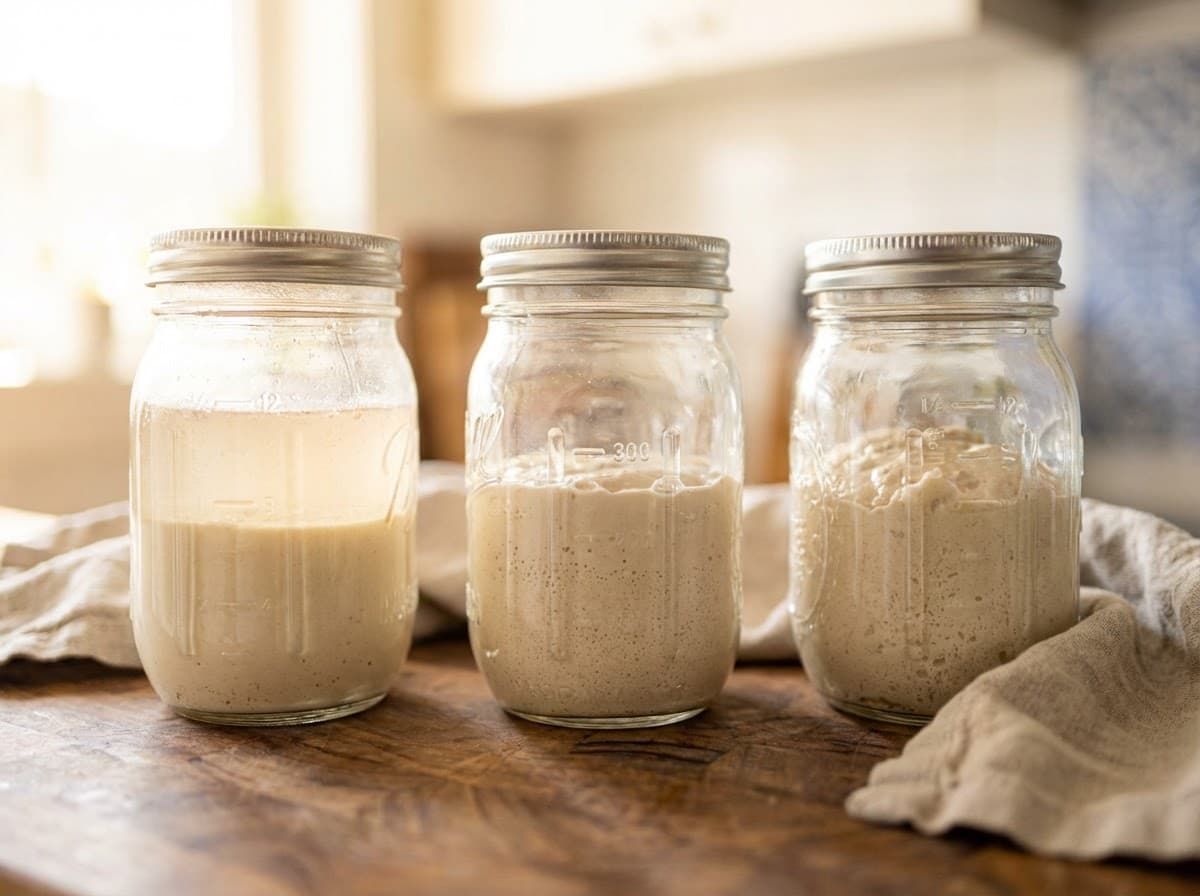
All sourdough starters are made from flour and water. The only real difference between the types is how much water you use -- the hydration level. And that single variable changes everything: how sour your bread tastes, how much it rises, and how forgiving the whole process is. Here's what each type does and when to use it.
Regular starter (100% hydration)
The regular starter uses equal parts flour and water by weight -- that's 100% hydration. If you've ever made a starter, this is almost certainly what you made. It's the most common type, the most universal, and the safest default for beginners.
A regular starter has a good balance of yeast and bacteria. It rises visibly after feeding, which makes it easy to judge readiness. The flavor profile lands somewhere between mild yogurt and gentle vinegar, depending on your specific microbial community.
Feed it at a 1:5:5 ratio (1 part starter, 5 parts flour, 5 parts water). It works well with wheat, rye, spelt -- basically anything. If you only ever use one starter type, this is the one. It's versatile, predictable, and low-maintenance.
Liquid starter (200-500% hydration)
A liquid starter uses way more water than flour -- typically 5 parts water to 1 part flour. The flour settles to the bottom and sits under a pool of water. It looks strange. It works brilliantly.
That layer of water changes everything. It cuts off oxygen to the fermenting flour, which shifts the bacterial population toward lactic acid producers and away from acetic acid producers. Translation: your bread tastes more like yogurt and less like vinegar. If you've ever found sourdough too sharp or pungent, a liquid starter conversion is the fix.
Fair warning: this conversion is permanent. Once you shift your microbial community toward lactic-dominant bacteria, it doesn't go back even if you return to 100% hydration. Keep a backup of your original starter before converting. To convert, take 1g of starter, add 5g flour and 25g water. Repeat daily for 3 days. You'll see tiny CO2 bubbles moving through the liquid -- that's your sign it's working.
The downside is more bacterial activity overall, which means faster gluten breakdown. You'll need strong, high-protein flour to compensate. This starter isn't great for weak flours.
Stiff starter (50-60% hydration)
The stiff starter is a game changer. It uses about half as much water as flour -- 50g of water for every 100g of flour. The consistency is like pizza dough or fresh pasta. It should hold together, slightly stick to your counter when lifted, but have no dry flour chunks.
In the drier environment, yeast thrives more than bacteria. That means more CO2 production and less acid production for any given amount of fermentation. Your bread rises more and tastes milder. This is huge if you're working with lower-gluten flour -- the kind you find in most European supermarkets. The reduced bacterial activity means less gluten breakdown, so your dough holds together longer.
The stiff starter balloon test proves the point. Put equal amounts of flour in three jars -- one with a liquid starter, one with a regular starter, one with a stiff starter. Stretch a balloon over each jar. The stiff starter inflates its balloon the most. More gas, less acid. Period.
If you could only pick one starter type, pick the stiff starter. It's more forgiving, produces consistently great results, and works as a direct replacement for commercial yeast in any recipe.
Lievito madre (pasta madre)
Lievito madre -- also called pasta madre -- is essentially an Italian stiff starter. After hours of research across Italian baking literature, the terms appear to be used interchangeably. It belongs to the same category as the stiff starter, typically kept at 50-60% hydration.
Some traditional recipes call for making lievito madre from dried fruits or fresh leaves rather than flour. This can work because wild yeast lives on fruit skins and plant surfaces. But there's a risk: fruit-based starters sometimes lack the bacterial component that creates the protective acidity. Without enough acid, pathogens can move in. If you go the fruit route, check that your starter's pH drops below 4.2 -- that's the food safety threshold.
Some Italian bakers bathe their lievito madre in water to wash out excess acidity. In practice, this doesn't do much to change the pH. The acid is distributed throughout the starter, not just on the surface. The bath might help if you're trying to shift toward anaerobic bacteria by submerging the starter, but that would require a much longer soak -- not just a quick rinse.
Bottom line: lievito madre is a stiff starter with an Italian name. Use the same techniques described in the stiff starter section above.
Which type should you choose?
If you're just starting out, go with a regular 100% hydration starter. It's the easiest to manage and judge. You can always convert later.
If your bread is too sour or not rising enough, try a stiff starter. The shift toward yeast-dominant fermentation fixes both problems at once. This is especially true if you're stuck with lower-protein flour.
If your bread is too sharp and vinegary, convert to a liquid starter to shift from acetic acid to lactic acid. Remember this is a one-way trip -- keep a backup.
You can switch between types freely (except for the liquid conversion). Just change the water amount in your feeding for 2-3 consecutive feedings and your microbes will adapt. I regularly bounce my starter between regular and stiff depending on what I'm baking that week.
The biggest takeaway: no matter which type you use, you can control sourness by how long you ferment. A stiff starter fermented for 24 hours will eventually produce just as much acid as a liquid starter. The difference is that for a given volume increase, the stiff starter will have produced the least acid, the regular starter a middle amount, and the liquid starter the most.