
Sourdough Scoring: Patterns, Designs, and How to Score Bread
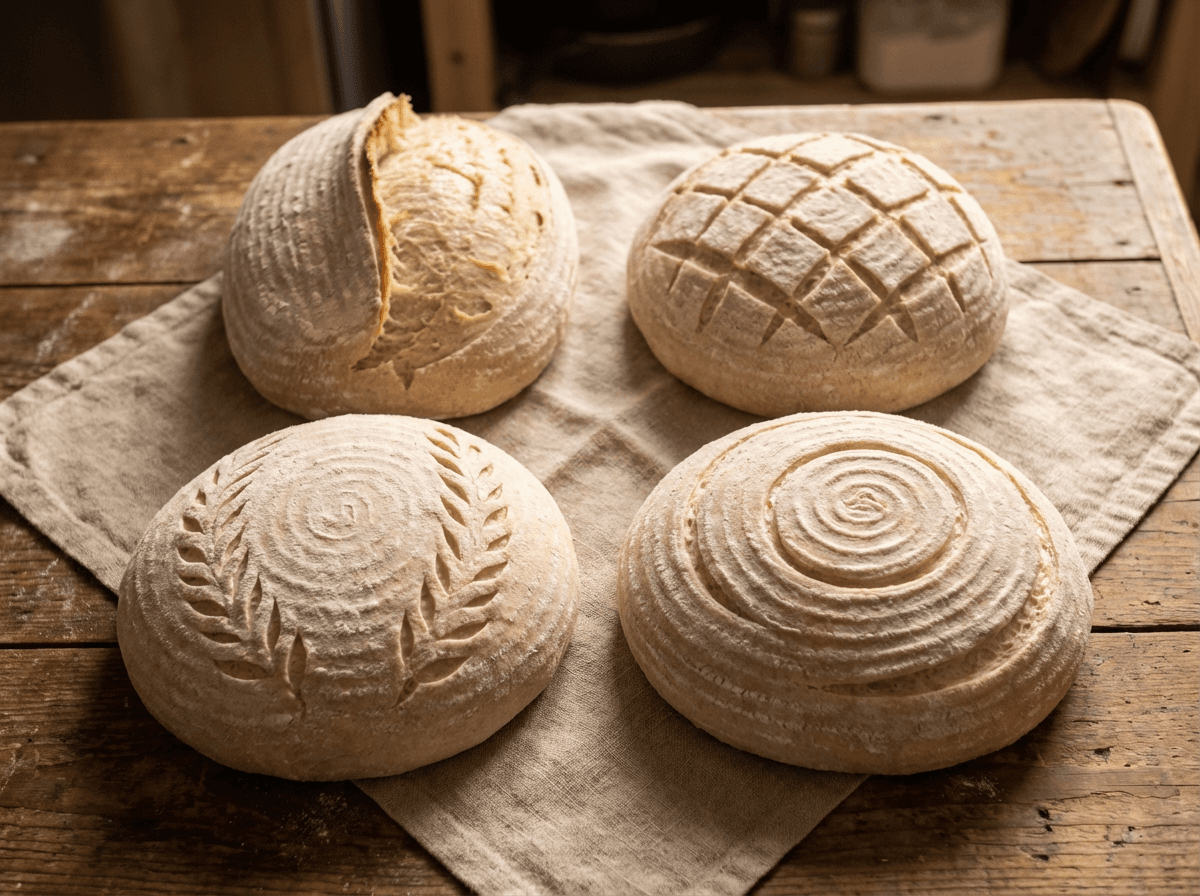
Scoring is the last thing you do before your bread hits the oven, and it has an outsized impact on how your loaf looks and bakes. A single confident slash can mean the difference between a proud, puffy loaf with a crispy ear and a sad blob that cracked open wherever it felt like it.
Why scoring matters (it's not just decoration)
Scoring serves a functional purpose before a decorative one. When your dough heats up in the oven, trapped CO2 expands rapidly and steam builds inside the loaf. That pressure needs somewhere to go. If you don't give it a controlled exit, the bread will crack open at the weakest point -- usually the seam from shaping -- and the result is unpredictable and ugly.
A score gives the dough a planned weak point. The bread expands through your cut, rising upward in a controlled way. This is oven spring in action -- that dramatic puffing in the first 10-15 minutes of baking.
Beyond function, scoring is where bread becomes art. Geometric patterns, leaf designs, wheat stalks -- all of these are created with nothing more than a sharp blade and a steady hand. But don't get ahead of yourself. Master the basic single slash first. Everything else builds on that foundation.
Tools you need
A razor blade is the best scoring tool. Specifically, a double-edge safety razor blade -- the kind you can buy in bulk for pennies. Some bakers attach the blade to a chopstick or wooden skewer for better control. Commercial tools called lames (pronounced "lahm") hold the blade in a curved position, which makes the classic ear-producing cut easier.
A very sharp serrated knife works in a pinch, but it tears the dough more than a razor blade. Clean cuts make cleaner ears. You want to slice, not drag.
If you're planning decorative patterns, rice flour is your best friend. Dust your dough generously with rice flour before scoring -- it won't brown during baking, so it creates high contrast between the scored lines (which open and darken) and the dusted surface (which stays white). Regular flour works too but the contrast isn't as dramatic.
The basic ear score
The "ear" is that thin, crispy flap of crust that peels back from a well-scored loaf. It's the hallmark of good sourdough. Here's how to get it.
Hold your blade at a 45-degree angle relative to the surface of the dough -- not vertical, not flat, but angled. Position the cut slightly off-center, running along the length of a batard or across the top of a boule. In one confident motion, slash about 1cm (half inch) deep. Don't saw back and forth. One clean pass.
The angle is what creates the ear. Because you're cutting at 45 degrees, one side of the cut has a flap that hangs over the other. As the bread expands in the oven, that flap lifts and bakes crispy while the exposed dough underneath blooms open. The thin edge gets extra dark and crunchy -- it's the best part of the bread.
If your blade drags instead of cutting cleanly, two things could be wrong: the blade isn't sharp enough, or your dough surface is too wet. A dull blade tears the dough and ruins oven spring. Wet dough sticks to the blade and creates ragged edges.
Scoring patterns and designs
Once you've got the single slash down, you can branch out. Here are the most common patterns:
Cross-hatch: Two or more parallel slashes at an angle, intersected by another set going the other direction. Creates a grid pattern that opens into a rustic, country-bread look. Keep cuts shallow for this one -- about 0.5cm deep.
Wheat stalk: A central line with angled leaf-shaped cuts branching off each side. Looks stunning with rice flour contrast. Score the main line first, then add the branches.
Spiral: Starting from the center and curving outward. Works best on boules. Keep consistent depth and spacing.
Leaf pattern: Score the outline of a leaf, then add a central vein and branching veins. This is advanced -- practice on a floured countertop or a ball of playdough before attempting on real dough.
For artistic scoring, use a finer blade or the tip of a razor blade held perpendicular to the dough. Decorative scores are shallower than functional ones -- you're creating surface-level designs that brown differently, not providing expansion channels.
Depth, angle, and speed
Depth: For functional scores (the ones that help your bread rise), go about 1cm (half inch) deep. For decorative scores, go shallower -- maybe 2-3mm. Too shallow on a functional score and the bread will still crack elsewhere. Too deep and you'll degas the dough.
Angle: 45 degrees for an ear. 90 degrees (straight down) for a clean split without an ear -- useful for decorative patterns or country-style loaves where you want an even opening.
Speed: Fast and decisive. The longer your blade is in contact with the dough, the more it drags and sticks. Think of it like ripping off a bandage. One smooth motion. Hesitation causes jagged lines.
If you're proofing at room temperature, the dough surface is softer and harder to score cleanly. Here's a trick: pop your shaped, proofed dough into the freezer for 20-30 minutes before scoring. The cold firms up the surface just enough to make clean cuts easy. Cold-proofed (fridge) doughs are already firm and score beautifully straight from the fridge.
Troubleshooting your scores
Score closes up during baking: Your cut wasn't deep enough, or the dough was underproofed (too much elasticity snapping the cut shut). Try going deeper and make sure your proofing is on point.
No ear forms: Check your angle. A 90-degree cut won't create an ear -- you need that 45-degree angle. Also check that you have enough steam in the oven during the first 15 minutes. Without steam, the crust sets too quickly and the score can't open properly.
Bread cracks on the bottom or sides instead of at the score: Your score wasn't deep enough to be the weakest point, or the dough is expanding too fast for the small opening you gave it. Make your score longer and deeper.
Blade drags through the dough: Either your blade is dull (replace it -- they're cheap) or your dough surface is too wet. Dust the surface with flour or use the freezer trick to firm things up.
Designs lose definition: You're scoring too deep for decorative work. Decorative cuts should be surface-level -- just enough to mark the dough, not enough to create expansion channels. Go lighter.