
Sourdough Troubleshooting: Every Problem, Solved
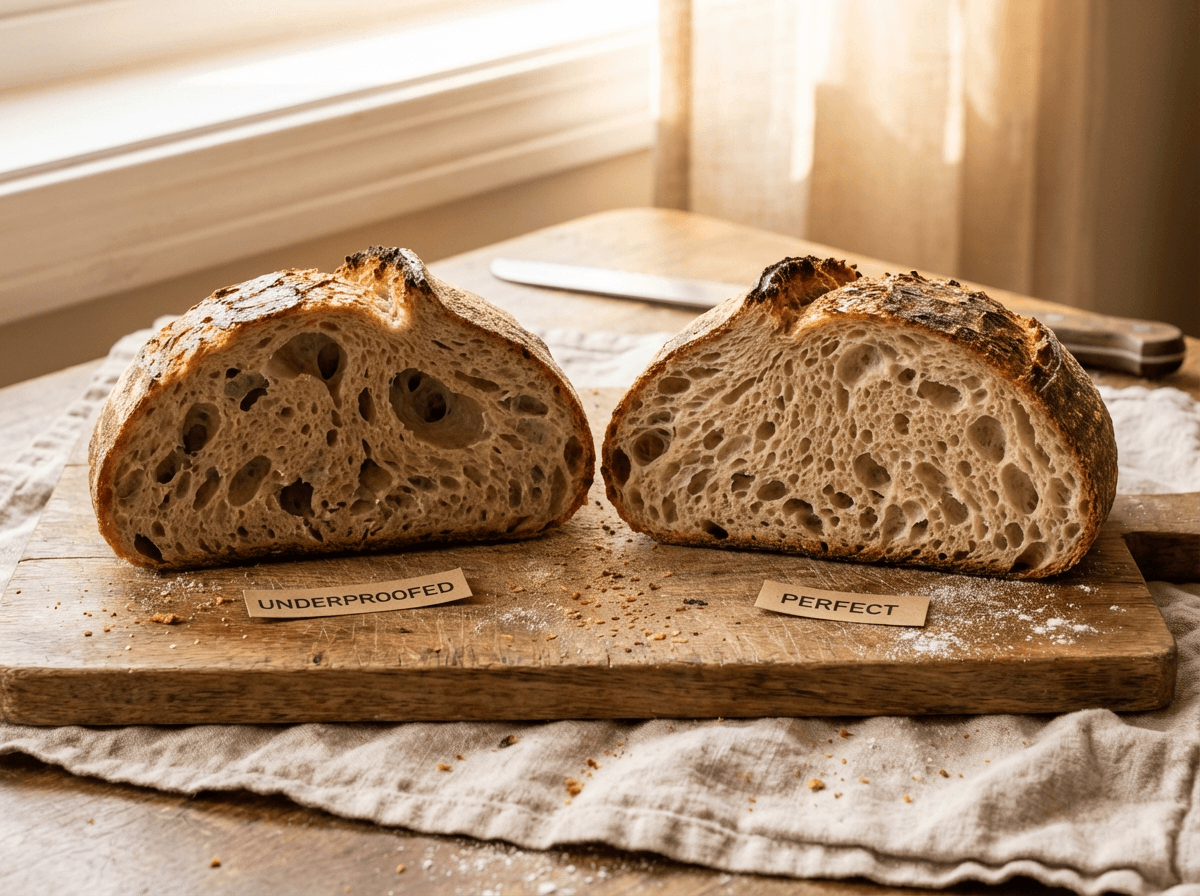
Something went wrong with your bread. That's normal -- it's basically a rite of passage. The good news is that most sourdough problems have straightforward fixes. Find your issue below, read the diagnosis, and apply the fix. No judgment. Every single baker has been here.
Starter won't rise at all
If your brand new starter has never risen, check the water first. Chlorinated tap water kills the microbes you're trying to grow. Switch to filtered or bottled water, or let tap water sit uncovered for 12-24 hours before using it.
Next, check your flour. Whole grain flour (whole wheat, whole rye) works best for new starters because the bran carries more wild yeast and bacteria. White flour has much less microbial contamination and can be painfully slow. Try organic, unbleached whole grain flour. Industrial flour is sometimes treated with fungicides that prevent growth.
If your starter rose on day 2-3 but then stopped, that's actually normal. The initial rise comes from bad microbes that are activated first. They get outcompeted by the flour-fermenting specialists over the next week. Keep feeding daily. The good microbes are growing -- you just can't see them yet because their population is still tiny. Give it 7-14 days before worrying.
Starter is too sour or smells like acetone
A pungent vinegar or nail polish smell means acetic acid has built up. This happens when your starter goes too long without feeding -- the bacteria run out of sugar, start consuming the ethanol produced by yeast, and convert it to acetic acid.
The fix is simple: feed more often. Do daily feedings at 1:5:5 or 1:10:10 for a few days. The wider ratio gives the microbes a clean slate of fresh food, and the frequency keeps the yeast/bacteria balance in check.
For a longer-term shift away from acetic acid, convert to a stiff starter (50-60% hydration). The drier environment favors yeast over acid-producing bacteria. Your bread will taste milder and rise more. If you want to go the other direction and shift to milder lactic acid instead, a liquid starter conversion (high hydration, flour submerged under water) eliminates acetic acid bacteria permanently. But that's a one-way trip -- keep a backup.
Hooch (dark liquid on top of starter)
That dark, sometimes black liquid gathering on your starter is called hooch. It's alcohol. It means your starter ate through all the available food and is waving a little flag that says "feed me."
Hooch is not mold. Don't throw your starter away. Stir it back in (which adds a bit of tang to your next bake) or pour it off. Then feed as normal. Your starter is perfectly fine.
The liquid turns dark because flour particles and dead microorganisms float in it. It also acts as a protective barrier -- mold is aerobic (needs air) and can't easily grow under a layer of liquid. If anything, hooch is your starter protecting itself.
Mold on the starter
Actual mold on a sourdough starter is rare. The acidity normally creates an environment that's too hostile for mold. If you're seeing mold, something unusual is going on.
The most common cause: the starter surface dried out, especially in the fridge. Mold can colonize dry patches that the active starter bacteria can't reach. Scrape off the moldy part, take a small amount of clean starter from deeper in the jar (even 1-2 grams is enough -- millions of microbes in there), and feed it fresh in a clean container.
If mold keeps coming back, convert to a liquid starter temporarily. Submerging the flour under water creates anaerobic conditions that mold can't tolerate. After 2-3 feedings in liquid form, the mold spores diminish with each cycle. Lactic acid bacteria also produce metabolites that actively inhibit mold growth. Switch back to your preferred hydration after the mold is gone.
If mold appears on a brand new starter (first week), just start over with different flour. Sometimes a batch of flour is particularly mold-heavy, and the starter hasn't developed enough acidity yet to fight it off.
Dough is too sticky and won't hold shape
Sticky dough has two main causes, and you need to figure out which one you're dealing with.
Cause 1: Not enough gluten development. If you didn't knead enough or didn't let the dough rest long enough for the gluten to form, it'll be slack and sticky. The fix is more kneading or longer rest times. Try the bassinage method -- start with lower hydration (60%) until you build a strong gluten network, then gradually add more water.
Cause 2: Over-fermentation. If your dough was fine earlier and then became a sticky mess after several hours, the gluten has been broken down by bacteria and the protease enzyme. Your fermentation went too long. There's no fixing this -- the gluten is gone. Move the dough to a greased loaf pan and bake it. It'll taste great even if it looks like a brick. Next time, shorten your bulk fermentation or use less starter.
Quick diagnostic: taste your dough. If it's very sour, that confirms over-fermentation. If it's relatively bland, it's probably a gluten development issue.
Dough tears when stretched
If your dough rips apart when you try to stretch or shape it, the gluten network has degraded past the point of no return. This is classic over-fermentation.
The protease enzyme in flour continuously breaks down gluten from the moment you add water. Meanwhile, bacteria also consume gluten. Given enough time, your dough will always tear -- it's just a question of when. If your fermentation took too long before the microbes could finish their work, the enzymatic breakdown won the race.
Fixes for next time: use a more active starter (so fermentation finishes before gluten degrades), use stronger (higher protein) flour, reduce fermentation temperature, or reduce fermentation time by using more starter. A stiff starter helps here because it shifts the balance toward yeast, which doesn't attack gluten the way bacteria do.
For now, that torn dough can still be used. Scrape it into a loaf pan. Or use a chunk as the starter for your next batch -- it's basically a big, over-fermented starter at this point.
Bread is dense and gummy inside
Two likely culprits: underfermentation or cutting too soon.
If you sliced into your bread within an hour of pulling it from the oven, that's probably it. The crumb is still setting as it cools -- steam is redistributing, starches are solidifying. Cutting early lets steam escape before the structure firms up, leaving a gummy, compressed center. Next time, wait at least two hours. Yes, it's painful. Yes, it's worth it.
If you waited and it's still gummy, your dough probably needed more time during bulk fermentation. The yeast didn't produce enough CO2 to open up the crumb. Try extending your bulk by 30-60 minutes next time, or use a warmer spot. An aliquot jar is your best friend here -- you can literally watch the rise happening in real time.
Another possibility: your oven temperature was too low. If the interior didn't get hot enough, the starches may not have fully gelatinized. Make sure you're baking at 230C (450F) or higher, at least initially.
Bread is flat (no oven spring)
A flat loaf that spreads sideways instead of rising upward is almost always related to gluten network failure. Your dough couldn't hold the gas.
Most common cause: over-fermentation. The bacteria ate too much of the gluten, so when the bread hit the oven, the remaining structure couldn't support the expansion. The gas just leaked out sideways.
Check your starter. If it's young or hasn't been fed recently, the bacteria/yeast balance might be off -- too much bacteria, not enough yeast. Apply daily feedings at 1:5:5 for several days. Better yet, try a stiff starter to boost yeast activity.
Check your flour. Low-protein flour (under 11% protein) has less gluten to start with, giving you a much smaller window before fermentation breaks it down. Use bread flour with at least 12% protein for freestanding loaves.
Also remember: rye-based breads will always be flatter than wheat breads. Rye has compounds called pentosans that prevent a proper gluten network from forming. If you're using a lot of rye, flat is normal -- use a loaf pan.
Finally, check your scoring. If you didn't score deep enough (or at all), the bread may have cracked at the seam instead of opening at the top. A 1cm deep score along the length of the loaf gives the bread a clear path to expand upward.