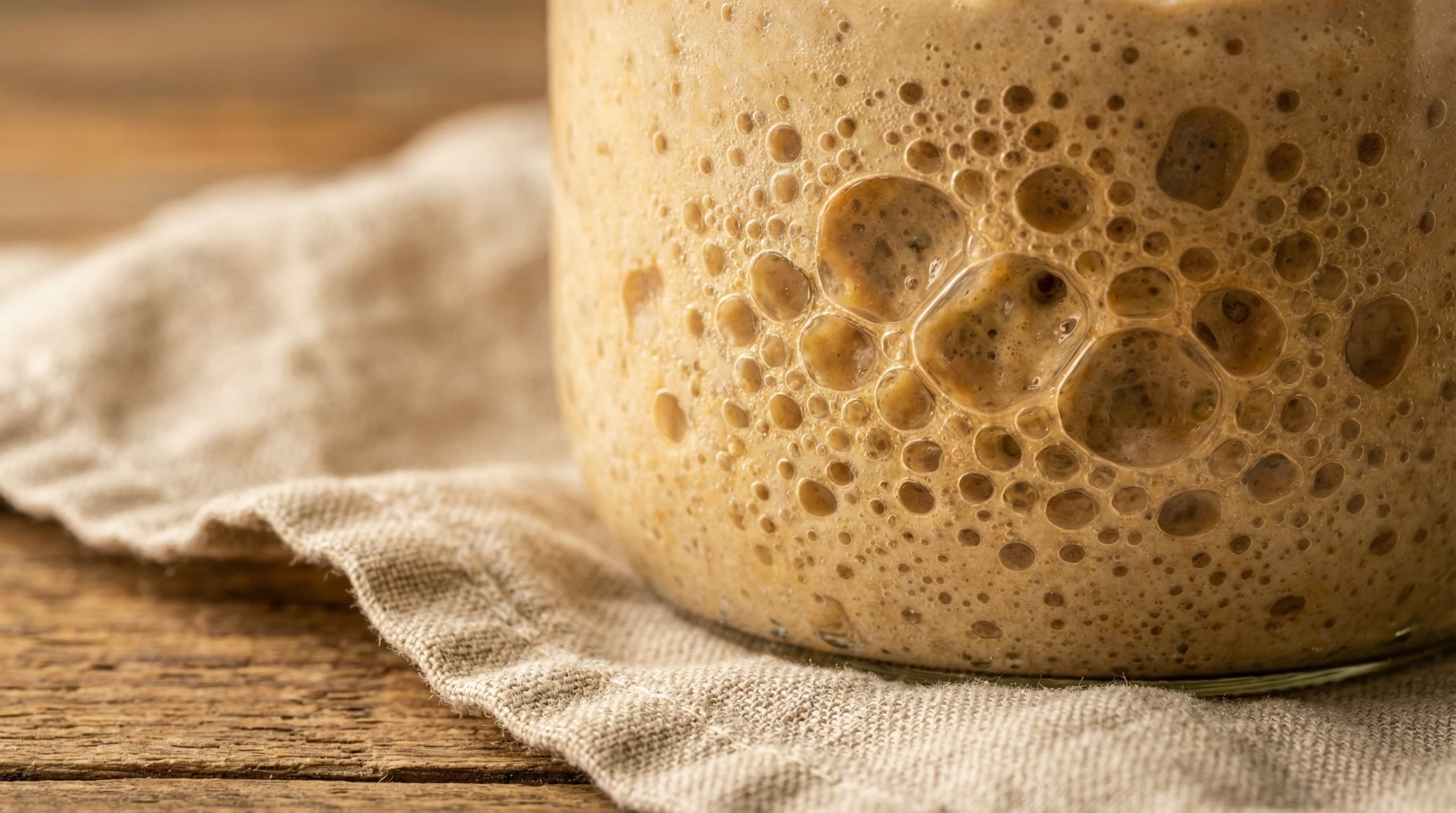
Sourdough isn't just a recipe. It's a biological process -- a collaboration between enzymes, wild yeast, and bacteria that transforms flour and water into something your body can use better and your taste buds appreciate more.
You don't need to understand the science to make great bread. But knowing what's happening inside your dough helps you make better decisions at every step. It's the difference between following a recipe and understanding a recipe.
Your sourdough starter is a stable ecosystem of wild yeast and lactic acid bacteria, maintained by daily or weekly feedings of flour and water. It's not random -- the microorganisms in a mature starter have been selected by their environment. The ones that are best at fermenting flour outcompete everything else.
The wild yeast (various species, though Saccharomyces cerevisiae and Kazachstania humilis are common) handles leavening. They eat sugars and produce carbon dioxide (the gas that makes bread rise) and ethanol. They're outnumbered by bacteria about 100 to 1, but they punch above their weight.
The lactic acid bacteria (LAB) handle flavor and preservation. They eat sugars and produce organic acids -- primarily lactic acid (mild, dairy-like tang) and acetic acid (sharp, vinegar-like tang). Some species also produce small amounts of CO2 and ethanol.
Both groups of organisms live in a delicate balance. They cooperate in some ways (the bacteria create an acidic environment that protects the yeast from pathogens) and compete in others (they're both after the same sugars). This tension is what makes sourdough fermentation so much more complex and flavorful than a simple yeast fermentation.
Wild yeast are single-celled fungi that live on the surfaces of plants, including cereal grains. They're epiphytes -- organisms that live on the outside of plants, feeding on sugars released through the plant's surface. In exchange, they help protect the plant from pathogens. When the grain is milled into flour, the yeast come along.
Unlike commercial baker's yeast (a single, domesticated strain bred for speed), wild sourdough yeast are diverse. Your starter likely contains multiple yeast species, each adapted to the specific flour and conditions of your kitchen. They work slower than commercial yeast, but they produce a wider range of flavor compounds.
Wild yeast are also more acid-tolerant than commercial yeast. They have to be -- they live alongside bacteria that are constantly producing organic acids, driving the pH down to levels that would kill less adapted organisms. This tolerance is what allows the sourdough ecosystem to function. Even at pH 3.5-4.0, the yeast keep working.
Yeast can survive a remarkable range of conditions. They function both with and without oxygen (aerobic and anaerobic respiration). In the presence of oxygen, they produce mainly CO2 and water. Without oxygen (like deep inside a ball of dough), they shift to producing more ethanol. The temperature at which they work best depends on the conditions where the grain was grown -- northern European rye starters may contain cold-adapted yeast, while Mediterranean wheat starters may have warmth-loving varieties.
Bacteria are the dominant organisms in sourdough. They outnumber the yeast about 100 to 1, and they're responsible for everything that makes sourdough taste and behave differently from yeasted bread.
There are two main categories of LAB in sourdough:
Homofermentative LAB produce primarily lactic acid. Just lactic acid. This gives bread a milder, creamier tang -- similar to yogurt.
Heterofermentative LAB produce lactic acid plus acetic acid, ethanol, and even some CO2. The acetic acid is what gives sourdough its sharper, more vinegary bite. The most famous heterofermentative species is *Fructilactobacillus sanfranciscensis*, named after San Francisco sourdough.
The ratio of lactic to acetic acid in your bread determines its flavor profile. More lactic acid = milder, creamier. More acetic acid = sharper, tangier. You can influence this ratio somewhat through temperature and hydration, though the specific strains in your starter play the biggest role.
Beyond flavor, the bacteria serve as a defense system. The organic acids they produce lower the pH of the dough to levels hostile to most pathogens. This is why sourdough bread lasts so long without preservatives and why sourdough starters are so resistant to contamination. Some LAB also produce bacteriocins -- antimicrobial peptides that actively kill competing microorganisms.
Yeast and bacteria in sourdough don't simply coexist -- they have a complex, sometimes cooperative, sometimes competitive relationship that scientists are still working to fully understand.
The cooperative side: yeast produce ethanol, which some bacteria can metabolize into organic acids. Bacteria create an acidic environment that protects the entire ecosystem from unwanted pathogens, and the yeast tolerate this acidity well enough to keep working. Both organisms benefit from the enzymes in the flour breaking down starches and proteins into simpler, more digestible compounds.
The competitive side: both yeast and bacteria want the same sugars. Research suggests they may even produce compounds that inhibit each other's ability to feed -- each trying to slow the other down. Some evidence indicates they partially specialize: certain bacteria prefer maltose while yeast prefer glucose, which reduces direct competition. But the relationship is messier than a clean division of labor.
This competition is actually productive. It drives both organisms to metabolize more thoroughly and produce more complex byproducts. A pure yeast fermentation is efficient but one-note. A sourdough fermentation is an arms race that produces hundreds of flavor compounds, better preservation, and improved nutrition. The bread benefits from the rivalry.
The moment flour and water meet, two types of reactions begin. Understanding both is key to understanding sourdough.
Enzymatic reactions (from the flour itself): amylase breaks starches into simple sugars (maltose and glucose). Protease breaks down gluten proteins into smaller peptide chains and free amino acids. These enzymes exist in the grain because a seed needs them to sprout -- but since the grain has been ground, the enzymes activate without producing a new plant. Instead, they create a feast for the microorganisms.
Microbial fermentation (from the starter): yeast consume sugars and produce CO2 (leavening) and ethanol. Bacteria consume sugars and produce organic acids (flavor and preservation). Both populations grow exponentially during the first hours, then plateau as the food runs out and the acid builds up.
These two processes interact. The sugars freed by amylase feed the yeast. The amino acids freed by protease contribute to the Maillard reaction during baking (better crust color and flavor). The protease also breaks down gluten bonds, making the dough progressively more extensible -- easier for the yeast to inflate, like stretching a thin balloon instead of a thick rubber tire.
But the protease doesn't stop. If fermentation goes too long, too much gluten breaks down, and the dough becomes a sticky mess that can't hold gas. Finding the sweet spot -- enough gluten breakdown for a light, airy crumb, but not so much that the dough collapses -- is the central challenge of sourdough baking.
As bacteria produce organic acids, the pH of your dough drops from around 5.5-6.0 (freshly mixed) to 4.0-4.5 (end of fermentation). This matters for several reasons.
Flavor: the organic acids themselves are the source of sourdough's tang. Lactic acid contributes a mild, dairy-like sourness. Acetic acid contributes a sharper, vinegary bite. The balance between these acids -- determined by your starter's bacterial composition and your fermentation conditions -- defines your bread's flavor profile.
Preservation: the low pH inhibits mold and pathogenic bacteria. Foods with a pH below 4.2 are generally considered microbiologically safe. This is why sourdough bread lasts 5-7 days without preservatives, while commercial yeasted bread needs calcium propionate and other additives to achieve the same shelf life.
Self-regulation: the increasing acidity eventually slows down and stops the fermentation. The bacteria that produced the acid become inhibited by their own byproducts. The yeast slow down too. This self-limiting nature prevents the dough from fermenting indefinitely -- it reaches a natural plateau.
Baking effect: some organic acids (especially acetic acid) evaporate during baking. This means your bread will taste less sour than the raw dough. Longer, hotter bakes drive off more acidity, giving you another lever for controlling flavor. A bread baked for 50 minutes will taste milder than the same bread baked for 40 minutes.
Temperature affects every aspect of sourdough fermentation. It controls the speed of enzymatic reactions, the rate of microbial reproduction, and indirectly, the flavor balance.
Warmer (25-30C / 77-86F): everything speeds up. Yeast reproduce faster. Bacteria produce acids faster. The window between "perfectly fermented" and "overfermented" gets narrower. In summer heat, you'll need less starter (as little as 1-5%) to avoid overshooting your fermentation window.
Cooler (15-20C / 59-68F): everything slows down. Fermentation takes longer, but enzymes keep working at a relatively consistent rate. This means more enzymatic breakdown per unit of fermentation -- more sugars for crust browning, more amino acids for Maillard flavor, more extensibility for an open crumb. Cool, slow fermentation is the secret to great bread.
Cold (3-5C / 38-41F): fermentation nearly stops. This is your fridge. You use it to retard (slow down) proofing, giving yourself scheduling flexibility. The enzymes still work at a reduced rate even at fridge temperature, continuing to develop flavor very slowly.
There's a common claim that cold fermentation favors acetic acid (more tang) while warm fermentation favors lactic acid (milder). The scientific evidence for this is mixed. What's more likely is that different bacterial strains thrive at different temperatures, and those strains produce different acid profiles. Your starter's microbiome adapts to whatever temperature you consistently use.
Every advantage sourdough has over commercial bread comes down to time.
Flavor: the hundreds of flavor compounds in sourdough are produced by slow microbial metabolism. A 2-hour yeast fermentation simply doesn't generate the diversity of acids, alcohols, esters, and aldehydes that a 12-hour sourdough fermentation does. The enzymatic conversion of starches to sugars also needs time -- and those sugars are what brown and caramelize during baking.
Texture: the protease enzyme needs time to partially break down gluten, creating the extensible dough that bakes into a light, airy crumb. A quick-rise yeast dough doesn't get this benefit, which is why fast-fermented bread has a denser, chewier crumb. Neapolitan pizza makers discovered this centuries ago -- they use a tiny amount of yeast and let the dough ferment for 24-72 hours.
Nutrition: phytase (which breaks down phytic acid and frees up minerals) needs an acidic environment and time to work. Short fermentations barely dent the phytic acid content. Long sourdough fermentations reduce it by 50-80%, making iron, zinc, and other minerals significantly more bioavailable.
Digestibility: the partial breakdown of gluten and FODMAPs during long fermentation is what makes sourdough easier on the gut. Short fermentations don't achieve meaningful reductions in these compounds.
Preservation: the organic acid production that preserves sourdough bread is a slow, cumulative process. Quick-rise bread doesn't produce enough acid to inhibit mold, which is why it needs preservatives.
Slow fermentation is the key to making great bread. If you only learn one thing from this page, let it be that. Use less starter, give your dough more time, and the bread will be better in every way that matters.
